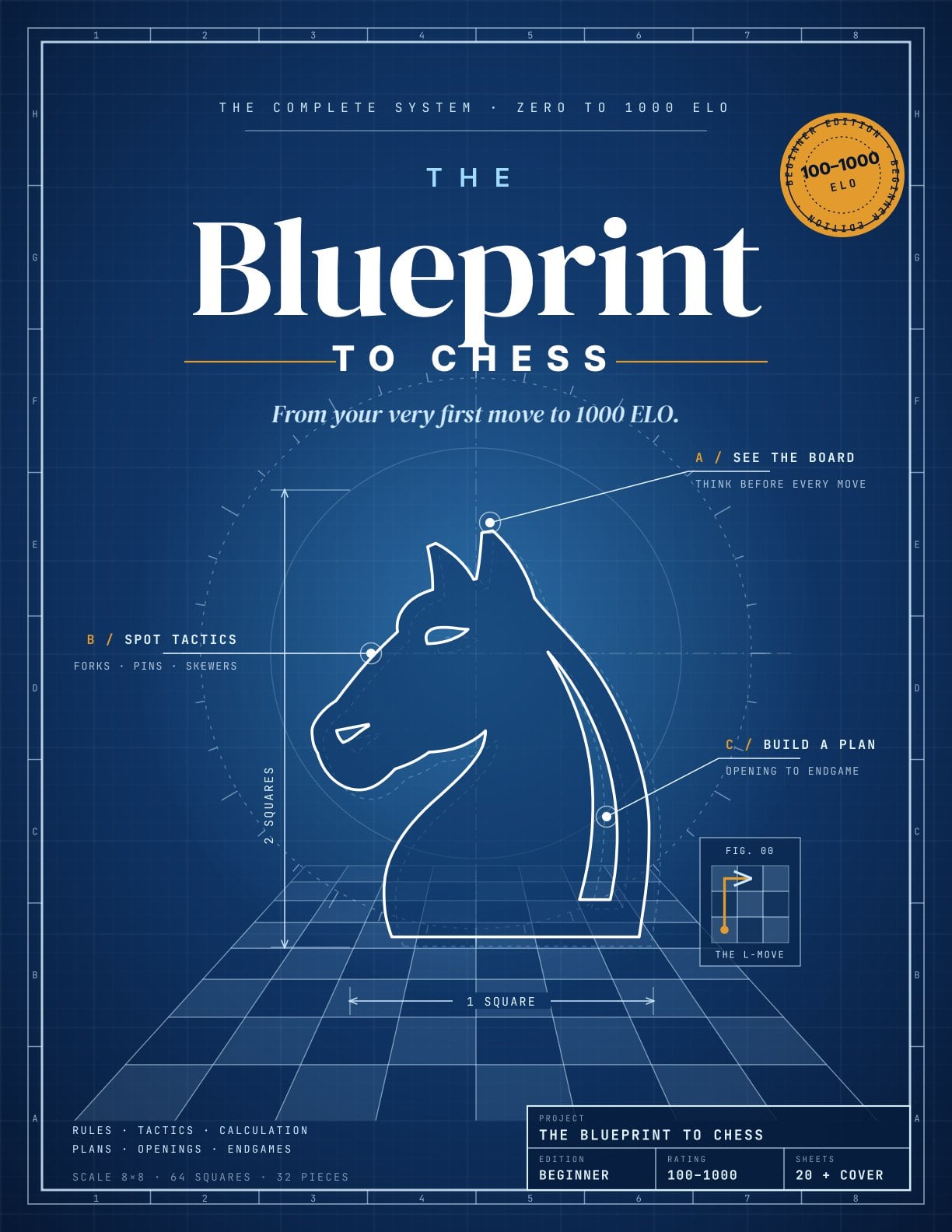
A step-by-step visual guide for players who keep losing games they should win. 20 sheets that take you from your first move to winning endgames. No 400-page books. No guesswork. Just the plan.
You're winning, you make a normal-looking move, and your queen is gone. You never saw the attack coming.
The opening's over and you're just shuffling pieces, waiting for your opponent to make a mistake first.
You get a winning position, then stalemate them, or let them back into the game in the endgame.
Below 1000, games aren't won by brilliance. They're won by the player who makes fewer simple mistakes. That's a skill, and it can be learned step by step.
Every sheet builds on the last, like floors of a building. Master them in order and you always know exactly what to learn next.
Every piece, check, mate and the draws that catch beginners out.
SHEETS 02–05Piece values, counting, and never leaving a piece hanging again.
SHEETS 06 · 11Forks, pins, skewers, discovered attacks and the classic mates.
SHEETS 07–10 · 12–13Candidate moves, pawn structure, active pieces, a real repertoire.
SHEETS 14–17Endgame technique so winning positions become won games.
SHEETS 18–20Each sheet teaches one skill with real diagrams, arrows and plain-English explanations, plus a drill to make it stick. Here's what you walk away with.


A four-step routine you run on every move, so nothing catches you by surprise.
SHEETS 06 · 10 · 11Simple counting rules that tell you instantly whether a capture is safe.
SHEETS 06 · 11Forks, pins, skewers, discovered attacks, deflection, overloading and more.
SHEETS 08 · 12 · 13A step-by-step method for checking forcing moves before you play them.
SHEET 14Read the pawn structure, find outposts and open files, and improve your worst piece.
SHEETS 15–17The opposition, the rule of the square, rook endgames and converting a win.
SHEETS 18–19This is one of the checkpoint puzzles from Sheet 10. Pick a move:
Every concept shown on a real board, with arrows and highlights.
Practice tasks on most sheets, with answers printed upside down.
A weekly schedule and a 60-day mission checklist.
Checkpoint puzzles at 400 and 1000 to prove your progress.

Less than the cost of a single chess lesson.
Checkout is handled securely by Fourthwall. As soon as your payment goes through you get access to the PDF download, so you can start reading in under a minute.
No. Part I starts from zero: how to set up the board and how every piece moves. Part II only begins once you've got the foundations, with a checkpoint to tell you when you're ready.
Yes. The skills are the same on every site. Rating numbers differ between platforms (Lichess ratings usually run higher), but the ideas that win games below 1000 are identical.
No book can play your games for you. What the blueprint gives you is the exact list of skills that decide games below 1000, in the right order, with drills and a training plan. Follow it and play regularly, and you'll know exactly what to work on next.
Yes. It's a standard PDF that works on any phone, tablet or computer. It also prints well, and many players like to keep the sheets next to the board.
No. You pay $9.99 once and the PDF is yours to keep.
20 sheets. 62 diagrams. One clear path from your first move to 1000 ELO.